
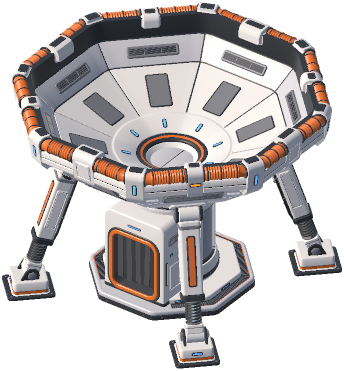
How it works
The analyzed game code routes a catch to payment when no belt is connected to the outfeed. With a belt connected, it stores the received dust for the conveyor route. Exact payout and delivery timing have not been measured in-game.
The catcher has a separate 100 kg buffer constant and one named OUT port. Its capacity is not the robot’s onboard capacity or a production rate.
At a glance
- Catcher buffer constant
- 100 kg
Named ports
These labels come from the serialized build definition. Verify orientation after placing the machine in-game.
Direct payment or a conveyor output
The game’s build-menu description says the catcher receives capsules from J.O.O.N.A.S. and sends dust to the Collector for payment. In the analyzed 0121bf5e code, a catch with no belt at its output follows a payment branch; a connected belt instead routes the received dust into catcher storage for output.
Choose a direct-payment test if you want the delivered dust paid out, or connect OUT when you want to route it elsewhere. The extracted branch does not establish every payout modifier, belt timing or save-specific condition; verify the result in your game.
How J.O.O.N.A.S. selects a catcher
The 1.0.5 notes describe choosing the emptiest catcher in the nearest group, with catchers within 100 m grouped and delivery shifting to another group when all catchers in the first are over 80% full. The analyzed code also accounts for booked incoming catches when estimating available room, so the displayed storage alone may not explain the choice.
If no candidate passes the first busy threshold, the code retries without that threshold while still excluding catchers marked full. Reservation weighting and this fallback are reconstructed from static code; actual selection and boundary behavior have not been tested in-game.
Keep the capacities separate
The analyzed code contains a 100 kg catcher buffer constant. The J.O.O.N.A.S. prefab has a separate 60 kg onboard capacity field. These numbers are buffers in different parts of the route, not a measured cleaning speed or a guaranteed continuous delivery rate.
The build definition lists a $1,500 base price and an OUT port. After placing a catcher, test the intended outcome: a payment without an output belt or an observable capsule moving along the connected route.
If it isn’t working
- If no catcher has been built, the game description says J.O.O.N.A.S. waits with a full bin until one is available.
- If the connected output backs up, inspect the belt and destination. To compare the direct-payment path, test a catcher without a connected outfeed in your own save.
Frequently asked questions
Does a capsule catcher need a conveyor belt?
In the analyzed code, a catch without an output belt follows a payment branch; with an output belt, received dust enters catcher storage for the route. Verify the result and payout in your game.
How much does a capsule catcher cost?
Its extracted building definition lists a $1,500 base price. Runtime price and availability have not been verified.
Is the 100 kg catcher capacity a production rate?
No. It is a buffer constant in the analyzed code, separate from the robot’s onboard capacity and from throughput per minute.
Which port does the catcher use for a conveyor?
The extracted build definition names one output port OUT. Verify its orientation after placing the catcher.
Base price, ports and numeric specifications are from static game files for build f87fd7e5. Performance and actual placement have not been verified in-game. Game updates can change these values. Read the methodology. For the described changes, see the developer’s 1.0.5 notes. Selected values were compared with the newer 0121bf5e package, but runtime behavior has not been verified.